
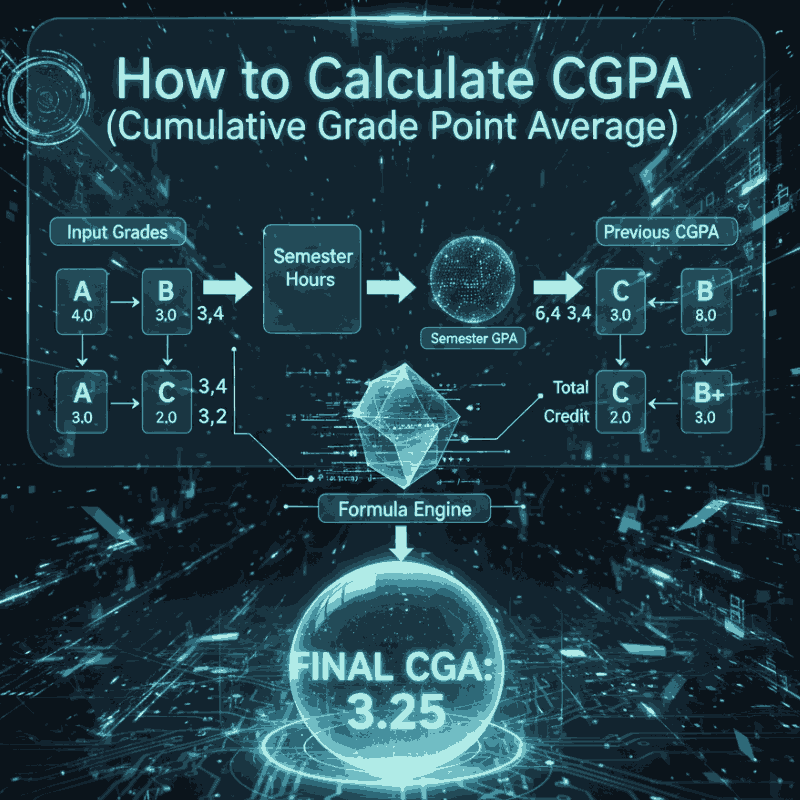
To calculate CGPA, multiply each course’s grade point by its credit, add all those values, and then divide by the total number of credits. This gives your cumulative grade point average across semesters. You can instantly find your CGPA using this cgpa calculator.
If you want to convert CGPA into a percentage, most universities use either CGPA × 9.5 or CGPA × 10. You can easily find it using the cgpa to percentage calculator on our site.
Understanding What CGPA Means
Before we move to formulas and examples, let’s understand what CGPA actually represents.
CGPA (Cumulative Grade Point Average) is a numerical measure of a student’s overall academic performance across all semesters or courses. It’s a standardized way of assessing how well a student has performed, considering the grades earned in different subjects and their corresponding credit weightages.
If you’re wondering how to calculate CGPA from marks or how to calculate overall CGPA of all semesters, this guide breaks it all down for you — with authentic examples, formulas, and step-by-step explanations.
For quick and accurate results, you can use our cgpa calculator — it’s designed to handle both semester-wise and mark-based inputs.
If you want to skip manual calculation, you can use tools like:
- CGPA Calculator – for quick CGPA computation
- CGPA to Percentage Calculator – to convert CGPA into a percentage
- VIT CGPA Calculator – specific for Vellore Institute of Technology students
What is CGPA?
CGPA stands for Cumulative Grade Point Average, which represents the overall academic performance of a student over multiple semesters. It is measured on a scale (usually 10-point or 4-point) depending on the country or institution.
- 10-Point Scale: Common in Indian universities such as VIT, DU, and CBSE schools.
- 4-Point Scale: Used in most US universities.
CGPA is more comprehensive than SGPA because it considers the cumulative performance across all semesters.
1. What Are Grade Points and Credits?
To calculate CGPA correctly, you must understand two key terms: Grade Points and Credits.
- Grade Points: These are numeric values assigned to letter grades. For example, on a 10-point scale,
- A = 10
- B = 8
- C = 6
- D = 5
- F = 0
- Credits: Credits represent the importance or workload of a course. A 4-credit course has more weight than a 2-credit course.
Your GPA and CGPA calculations are credit-weighted averages, not simple averages. That’s why two students with similar grades can have different CGPAs if their course credits differ.
Common Credits per Semester by Country
The number of credits students take each semester varies by country, depending on their education system, course intensity, and degree structure. Understanding these averages helps when comparing CGPA or GPA internationally.
- United States (15–16 Credits per Semester):
In most U.S. universities, a full-time undergraduate student enrolls in about 15 to 16 credits each semester. Each subject typically carries 3 to 4 credits, and completing 120–128 credits is required for a bachelor’s degree. This credit load allows students to balance core, elective, and general education courses across four years. - Canada (15 Credits per Semester):
Canadian universities follow a system similar to the U.S., where students usually take five 3-credit courses per term, making up 15 credits. This structure provides flexibility for co-op programs or internships while maintaining steady academic progress. - Pakistan (18–20 Credits per Semester):
In Pakistan, universities generally assign 18 to 20 credits per semester, especially in engineering, business, and computer science programs. This heavier load includes both theory and lab-based courses, aiming for a comprehensive understanding within shorter degree timelines. - India (22–24 Credits per Semester):
Indian universities using the Choice Based Credit System (CBCS) often assign around 22 to 24 credits each semester. Engineering and professional programs may have slightly higher credit requirements, which helps students build a broader academic foundation before specialization. - Malaysia (18–19 Credits per Semester):
Malaysian institutions typically keep the semester workload between 18 and 19 credits. This balance provides students with enough time for project work, practical sessions, and coursework without excessive academic pressure. - Germany (28–30 Credits per Semester):
Under the European Credit Transfer and Accumulation System (ECTS), German universities assign about 28 to 30 credits per semester. Each ECTS credit represents 25–30 hours of student work, which includes lectures, assignments, and self-study. This high total reflects Germany’s intensive academic structure. - Philippines (21–22 Credits per Semester):
Filipino universities usually assign around 21 to 22 credits per semester, combining theoretical lectures with lab courses. This load is designed to promote consistent learning while allowing students to participate in extra-curricular or part-time activities. - France (28–30 Credits per Semester):
France also follows the ECTS model with approximately 30 credits per term. Each course or module is carefully structured to contribute a set number of credits, making it easy for students to transfer or continue studies across other European countries. - Netherlands (28–30 Credits per Semester):
Like other European nations, the Netherlands assigns about 30 ECTS credits per semester. Programs are often modular, focusing on independent learning, group projects, and real-world application of concepts. - Saudi Arabia (17–18 Credits per Semester):
Universities in Saudi Arabia typically require 17 to 18 credits per semester. This structure allows students to balance academic and practical components, particularly in science and engineering programs where lab work is intensive.
2. Basic Formula to Calculate CGPA
The CGPA formula is simple and works universally across most universities:
CGPA Formula:
CGPA = (Sum of (Grade Point × Credit)) ÷ (Sum of Credits)
This formula calculates your cumulative average after considering every course or subject across semesters.
You can use this same formula in our online cgpa calculator by entering your grades and credits.
3. Step-by-Step Example to Understand CGPA Calculation
Let’s go through a practical example.
| Subject | Credits | Grade | Grade Point | Product (Credit × GP) |
|---|---|---|---|---|
| English | 4 | A | 10 | 40 |
| Physics | 3 | B | 8 | 24 |
| Chemistry | 3 | A | 10 | 30 |
| Mathematics | 4 | B | 8 | 32 |
Total Credits = 14
Total Weighted Grade Points = 126
Now apply the formula:
CGPA = 126 ÷ 14 = 9.0
Your CGPA for this semester is 9.0.
You can verify the same using the cgpa calculator.
4. How to Calculate CGPA from SGPA (Semester GPA)
To find overall CGPA when you already have SGPAs (Semester Grade Point Averages) for each term, use this weighted average formula:
Formula:
CGPA = (Σ(SGPA × Semester Credits)) ÷ (ΣSemester Credits)
Example:
| Semester | SGPA | Credits | Product (SGPA × Credits) |
|---|---|---|---|
| 1st Semester | 8.5 | 20 | 170 |
| 2nd Semester | 9.2 | 22 | 202.4 |
| 3rd Semester | 8.8 | 24 | 211.2 |
| 4th Semester | 9.0 | 20 | 180 |
CGPA = (170 + 202.4 + 211.2 + 180) ÷ (20 + 22 + 24 + 20)
CGPA = 763.6 ÷ 86 = 8.88
Your final CGPA = 8.88
If you’d like to automate this process, our scga to cgpa calculator does this for you instantly.
5. How to Calculate CGPA from Marks
If your result sheet only shows marks, you can still find CGPA using your university’s grade conversion chart. Most universities use the following general rule on a 10-point scale:
| Marks Range (%) | Grade Point |
|---|---|
| 90–100 | 10 |
| 80–89 | 9 |
| 70–79 | 8 |
| 60–69 | 7 |
| 50–59 | 6 |
| 40–49 | 5 |
| Below 40 | 0 (Fail) |
Once you convert marks to grade points, use the earlier CGPA formula to calculate your final CGPA.
Our gpa conversion calculator also lets you convert between 4.0 and 10.0 scales.
6. How to Calculate Percentage from CGPA
The conversion from CGPA to percentage depends on your university. Different institutions use different formulas.
Common Formulas:
| University Rule | Formula | Example |
|---|---|---|
| Standard Rule | Percentage = CGPA × 10 | 8.5 CGPA → 85% |
| VIT University | Percentage = CGPA × 10 | 9.2 CGPA → 92% |
| Some Indian Boards | Percentage = CGPA × 9.5 | 7.8 CGPA → 74.1% |
| Other Institutions | Percentage = (CGPA − 0.75) × 10 | 8.6 CGPA → 78.5% |
You can use our cgpa to percentage calculator to test all formulas and find accurate results.
7. How to Find Percentage from CGPA: Real Example
Let’s calculate the percentage for a student with CGPA 8.2.
- If your university uses ×10:
8.2 × 10 = 82% - If it uses ×9.5:
8.2 × 9.5 = 77.9% - If it uses (CGPA − 0.75) × 10:
(8.2 − 0.75) × 10 = 74.5%
Different universities follow different conversions. Always verify your official conversion rule before using CGPA in applications.
8. How to Calculate Overall CGPA of All Semesters
To find your overall CGPA, combine all your semester SGPAs and credits:
Formula:
Overall CGPA = (Σ (SGPA × Credits)) ÷ (Σ Credits)
This ensures semesters with more credits have more influence on your final CGPA. Avoid simply averaging SGPAs without weighting by credits — it can mislead your result.
Our grade average calculator can also help summarize your semester data.
9. How the VIT CGPA Calculator Works
VIT (Vellore Institute of Technology) follows the simplest conversion rule where:
Percentage = CGPA × 10
So, if your CGPA is 8.75, your percentage is 87.5%.
To verify your VIT grades easily, use our vit cgpa calculator, which uses VIT’s official conversion table.
10. Convert SGPA to CGPA
Students often ask, how to convert SGPA to CGPA?
Here’s the process in simple terms:
- Find SGPA for each semester.
- Multiply each SGPA by its semester credit.
- Add them all together.
- Divide by the total credits.
This gives you your cumulative CGPA.
If you want to skip manual steps, try the scga to cgpa calculator.
11. Common Mistakes Students Make
Here are some common errors to avoid:
- ❌ Averaging SGPAs directly without considering credits.
- ❌ Using an incorrect grade-to-point scale.
- ❌ Ignoring university-specific CGPA to percentage formula.
- ❌ Rounding numbers too early (always round at the end).
- ✅ Always check the controller of examinations page for official conversion charts.
12. Expert Tips to Calculate CGPA Accurately
- Use a verified cgpa calculator instead of manual math to avoid errors.
- Always double-check your credit values.
- Know your university’s CGPA scale (4.0, 5.0, or 10.0).
- When converting to percentage, attach your university’s official conversion document for proof.
- Save your semester credit sheet — it’s needed when calculating your overall CGPA.
13. Sample CGPA Calculation Table (Summary)
| Semester | SGPA | Credits | Weighted SGPA |
|---|---|---|---|
| Semester 1 | 8.4 | 20 | 168 |
| Semester 2 | 8.7 | 22 | 191.4 |
| Semester 3 | 9.0 | 20 | 180 |
| Total | 62 | 539.4 |
Overall CGPA = 539.4 ÷ 62 = 8.7
14. Related Calculators
All these tools help in academic conversions and GPA management:
- CGPA Calculator
- CGPA to Percentage Calculator
- SCGA to CGPA Calculator
- VIT CGPA Calculator
- Unweighted GPA Calculator
- GPA Conversion Calculator
- Grade Average Calculator
15. Frequently Asked Questions
Q1: How to calculate CGPA from SGPA?
Multiply each SGPA by its semester credits, sum up all, and divide by total credits. You can also use the scga to cgpa calculator.
Q2: How to calculate percentage from CGPA?
Different universities use different rules. The most common are CGPA × 10 and (CGPA − 0.75) × 10. You can check yours with our cgpa to percentage calculator.
Q3: How to calculate CGPA from marks?
Convert marks to grade points using your institution’s table, then calculate CGPA using the formula (Total Grade Points × Credits) ÷ Total Credits.
Q4: What is 7.8 CGPA in percentage?
If your university uses ×10 rule → 78%, if ×9.5 rule → 74.1%. Use our percentage to cgpa calculator to confirm.
Q5: What is 7.2 CGPA in percentage?
It’s approximately 72% (if ×10 rule) or 68.4% (if ×9.5 rule).
16. Final Encouragement
Now you know exactly how to calculate CGPA step-by-step with formulas, examples, and official conversion tables. Whether you’re trying to find your overall CGPA, convert it to percentage, or compare results from different universities — our free tools make it easier than ever.
Start by using the cgpa calculator or cgpa to percentage calculator and save your time from manual calculations.
Once you learn these simple formulas, you’ll never struggle again with questions like “how to calculate cgpa from sgpa” or “how to calculate cgpa from marks.”
Official References and Resources
AICTE Academic Handbook – Credit and GPA calculation methods
https://aicte-india.org
Vellore Institute of Technology (VIT) – Official CGPA Conversion Policy: Percentage = CGPA × 10
https://vit.ac.in
University Grants Commission (UGC) – Guidelines on CBCS and Grading System in Indian Universities
https://ugc.ac.in
Central Board of Secondary Education (CBSE) – CGPA to Percentage Conversion Circular (Formula = CGPA × 9.5)
https://cbse.gov.in
University of Delhi – Official Notification: Conversion of CGPA into Percentage
https://du.ac.in