
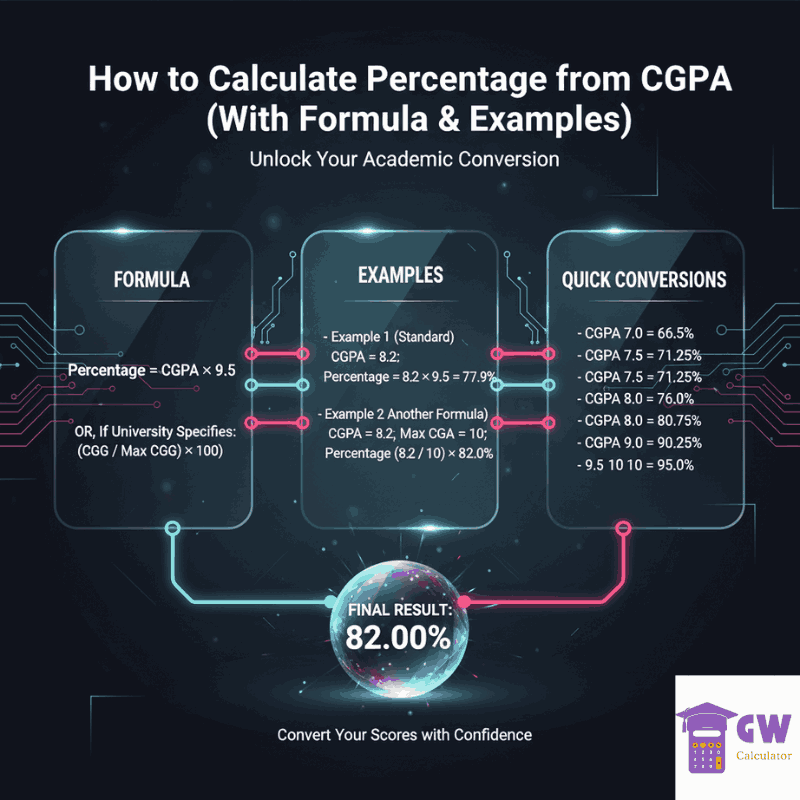
To calculate percentage from CGPA, multiply your CGPA by 9.5. For example, if your CGPA is 8.2, your percentage will be 8.2 × 9.5 = 77.9%. This conversion is widely used by CBSE and many Indian universities, though some institutions like VTU, SPPU, and Mumbai University use their own formulas. You can instantly check your result using this free CGPA Calculator or the CGPA to Percentage Calculator.
1. Introduction – How to Calculate Percentage from CGPA
When students receive their results in CGPA (Cumulative Grade Point Average), one of the first questions that comes to mind is how to understand it in percentage terms. Most universities in India and abroad use CGPA for grading, but employers, scholarship panels, and overseas admission offices often ask for a percentage format. That’s why knowing how to calculate percentage from CGPA is important for academic and professional purposes.
What Is CGPA and Why It Matters
CGPA represents the average of your grade points earned in all subjects across semesters. It gives a compact summary of your performance without showing each individual score. However, many forms and application systems still request a percentage value instead of CGPA, making it necessary to convert accurately.
For example, if your university uses a 10-point grading scale, the simplest way to convert is by multiplying your CGPA by 9.5 — a rule widely accepted across Indian education boards and universities.
Example:
If your CGPA = 8.2
Percentage = 8.2 × 9.5 = 77.9%
But not every university follows this exact rule. Some have their own conversion formula based on academic council guidelines. For instance:
- VTU: Percentage = (Cumulative CGPA – 0.75) × 10
- Mumbai University: Percentage = (CGPA × 7.1) + 11
- SPPU (Pune University): Percentage = CGPA × 8.9
Because of these variations, students should always confirm with their official university conversion chart or use trusted tools like the CGPA to Percentage Calculator which provides accurate results according to the institution’s system.
Why Many Students Want to Know How to Calculate Percentage from CGPA
Across India, millions of students receive grades in CGPA but require percentage values when:
- Filling out college admission forms abroad
- Applying for government or private jobs
- Submitting scholarship applications that demand percentage-based criteria
- Comparing scores with peers across different education systems
In the USA or Canada, universities often evaluate your CGPA using a 4-point GPA scale. To understand how your score fits that system, you can use the Cumulative GPA Calculator for All Semesters or even a VIT CGPA Calculator if you’re from Vellore Institute of Technology.
Different Universities, Different Formulas
While the CBSE conversion rule (CGPA × 9.5) is the most popular, universities like VTU, DU, SPPU, MAKAUT, and Calcutta University often have unique equations. Therefore, you’ll see slight differences between your calculated percentage and the one printed on your marksheet. Always follow the official formula your institution provides to avoid discrepancies during documentation or verification.
If you’re unsure which scale your college follows, you can easily test both conversions using the CGPA Calculator and the CGPA to Percentage Converter on GradeWiseCalculator. Both tools support different systems, including 10-point and 4-point scales, so you can compare instantly.
💡 Quick Tip for Students
Always check your university’s academic regulations or student handbook for the exact conversion formula. Some colleges also publish an official circular that specifies how CGPA should be converted to percentage for transcripts. Keeping a copy of that document can help avoid confusion when applying to foreign universities or uploading marks online.
2. What is CGPA?
CGPA, or Cumulative Grade Point Average, is a grading method used by many universities to measure a student’s overall academic performance. Instead of representing marks as a percentage, the CGPA system uses grade points on a fixed scale—most commonly a 10-point scale in India. The goal is to provide a fair and consistent evaluation that reflects a student’s performance across all semesters or subjects.
In India, for example, universities following the University Grants Commission (UGC) guidelines usually calculate CGPA on a 10-point scale. A CGPA of 9.0 or above typically represents an excellent academic record, while a CGPA around 6.0 is considered average. The CGPA model is widely used by institutions such as CBSE, UGC, and various autonomous universities to maintain standardization in grading.
However, when students apply for higher education abroad, most universities outside India—especially in the United States, Canada, and Europe—ask for marks or percentages rather than grade points. That’s why students often want to know how to calculate percentage from CGPA using a reliable method or online calculator such as the CGPA Calculator or the CGPA to Percentage Calculator. These tools make the conversion process easier and accurate for official forms and admission requirements.
CGPA vs Percentage – What’s the Difference?
While both CGPA and percentage represent a student’s academic performance, they differ in how the scores are measured and presented.
- CGPA (Cumulative Grade Point Average): Reflects your average grade points obtained in all subjects, based on a scale of 10, 4, or 5 depending on your university. It focuses more on overall performance rather than raw marks.
- Percentage: Represents your performance as a number out of 100. It’s a more universal system, commonly used in job applications, scholarship forms, and international university admissions.
For instance, if your university uses the 10-point grading system, a CGPA of 8.5 can be roughly converted to 80–85% depending on the formula followed by the institution. To make this conversion accurately, you can use tools like the CGPA to Percentage Converter or VIT CGPA Calculator for specific universities.
Tip for Students
Before converting your CGPA, always check your university’s official conversion formula—each institution might have slight variations. For example, some use the formula Percentage = (CGPA × 9.5), while others may apply (CGPA × 10) or a custom formula. Using a Cumulative GPA Calculator for All Semesters can help you verify your average before applying the conversion.
3. Formulas Used to Calculate Percentage from CGPA (With Examples)
Converting CGPA to percentage isn’t the same for every university. Each board or institution follows its own method, but most are based on a simple linear formula. Understanding the formula will help you calculate your marks easily without confusion.
Common Formula to Convert CGPA into Percentage
The most widely accepted formula in India, especially by CBSE and several universities under UGC, is:
Percentage = CGPA × 9.5
This means you just multiply your overall CGPA by 9.5 to find your equivalent percentage.
For example:
If a student’s CGPA is 8.2,
then Percentage = 8.2 × 9.5 = 77.9%
So, if your CGPA is 8.2, your equivalent marks percentage is approximately 77.9%.
You can verify this instantly using the online CGPA to Percentage Calculator for faster and more accurate results.
Other University-Specific Conversion Formulas
Not all universities use the same conversion rate. Here are some examples:
- Anna University: Percentage = (CGPA – 0.75) × 10
- Mumbai University: Percentage = (CGPA × 7.1) + 11
- VIT (Vellore Institute of Technology): Percentage = (CGPA × 10)
- Pune University: Percentage = (CGPA – 0.5) × 10
If you’re studying in any of these institutions, you can use dedicated tools such as the VIT CGPA Calculator or the Cumulative GPA Calculator for All Semesters to ensure your conversion is correct according to the specific formula your college follows.
Example: Step-by-Step CGPA to Percentage Conversion
Let’s say a student has earned the following semester GPAs:
| Semester | GPA |
|---|---|
| 1 | 8.0 |
| 2 | 8.3 |
| 3 | 8.5 |
| 4 | 8.2 |
Step 1: Add all semester GPAs = 8.0 + 8.3 + 8.5 + 8.2 = 33.0
Step 2: Divide by number of semesters = 33.0 / 4 = 8.25 CGPA
Step 3: Convert CGPA to Percentage using formula:
8.25 × 9.5 = 78.37%
So, the final percentage is approximately 78.4%.
If you’d like to calculate this automatically, visit the CGPA Calculator and enter your semester GPAs to get your overall CGPA instantly before converting it into percentage.
Tip for Students
Always double-check your university’s official conversion notice or prospectus before using a standard formula. Some universities publish unique conversion tables. For complete accuracy, try the SCGA to CGPA Calculator first to find your semester CGPA, and then apply the correct percentage formula.
4. Official CGPA to Percentage Conversion Rules by Different Universities (India & Abroad)
Different universities and educational boards use their own conversion rules to calculate percentage from CGPA. While the CBSE system follows a simple 9.5 multiplier, many Indian and international universities use different formulas to match their academic grading standards. Understanding your institution’s official method helps avoid confusion during job applications, higher studies, or foreign admissions.
🔹 CBSE (Central Board of Secondary Education)
- Formula: Percentage = CGPA × 9.5
- Explanation: This formula was developed after analyzing the average marks and CGPA of all students who scored above 91 marks in Class 10.
- Example: If your CGPA is 8.4, then your percentage = 8.4 × 9.5 = 79.8%.
You can use the CGPA to Percentage Calculator to instantly find your result using the CBSE rule.
🔹 Anna University
- Formula: Percentage = (CGPA – 0.75) × 10
- Explanation: Anna University subtracts 0.75 from the CGPA before multiplying by 10, ensuring the percentage closely matches the internal evaluation system.
- Example: CGPA = 8.2 → (8.2 – 0.75) × 10 = 74.5%
For Anna University-specific results, use the Cumulative GPA Calculator for All Semesters.
🔹 Mumbai University
- Formula: Percentage = (CGPA × 7.1) + 11
- Explanation: Mumbai University uses a weighted formula that adds 11 to balance between internal and external exam performance.
- Example: CGPA = 7.8 → (7.8 × 7.1) + 11 = 66.38%
🔹 VIT (Vellore Institute of Technology)
- Formula: Percentage = CGPA × 10
- Explanation: VIT maintains a direct linear scale where CGPA 8.0 equals 80%.
- Example: CGPA = 8.6 → 8.6 × 10 = 86%
For accurate conversion, you can use the VIT CGPA Calculator.
🔹 Pune University (SPPU)
- Formula: Percentage = (CGPA – 0.5) × 10
- Explanation: This slightly adjusted scale prevents grade inflation and aligns with the university’s evaluation policy.
- Example: CGPA = 8.0 → (8.0 – 0.5) × 10 = 75%
🔹 Jawaharlal Nehru Technological University (JNTU)
- Formula: Percentage = (CGPA – 0.75) × 10
- Explanation: JNTU follows a similar approach to Anna University for fairness across branches.
- Example: CGPA = 8.5 → (8.5 – 0.75) × 10 = 77.5%
🔹 Delhi University (DU)
- Formula: Percentage = CGPA × 9.5
- Explanation: Delhi University uses the CBSE conversion rule for academic uniformity.
- Example: CGPA = 7.9 → 7.9 × 9.5 = 75.05%
🔹 International Universities (for comparison)
| Country | Typical GPA Scale | Conversion to Percentage |
|---|---|---|
| USA | 4.0 Scale | 4.0 = 100%, 3.0 = 75% |
| UK | Honours Classification | First Class (≥70%), Upper Second (60–69%) |
| Canada | 4.0 Scale | 3.7 ≈ 90%, 3.0 ≈ 80% |
| Australia | 7.0 Scale | 7.0 = 100%, 6.0 ≈ 85% |
You can also convert your international GPA to CGPA using the SCGA to CGPA Calculator, then apply your region’s official percentage formula.
💡 Quick Tip
If you’re applying for foreign universities, always attach a short “grading scale explanation” along with your transcripts. Institutions abroad often ask for the official conversion system your university follows, especially during WES or ECE evaluations.
5. Examples: CGPA to Percentage Conversion for Different Scenarios
Once you understand the formulas used by different universities, the next step is to apply them through real-life examples. This helps students clearly see how their Cumulative Grade Point Average (CGPA) translates into percentage marks depending on the grading system followed by their institution.
If you’re still unsure about your numbers, try the CGPA to Percentage Calculator for instant and accurate results.
🔹 Example 1: CBSE Conversion (Class 10 and 12)
Formula: Percentage = CGPA × 9.5
Example Calculation:
Let’s say you have a CGPA of 8.6.
Then, your percentage = 8.6 × 9.5 = 81.7%
Tip: This is the most common conversion method used across Indian boards, especially for school results.
🔹 Example 2: Anna University Conversion
Formula: Percentage = (CGPA – 0.75) × 10
Example Calculation:
If your CGPA is 8.4,
then (8.4 – 0.75) × 10 = 76.5%
You can quickly verify this using the Cumulative GPA Calculator for All Semesters if you have semester-wise credits.
🔹 Example 3: Mumbai University Conversion
Formula: Percentage = (CGPA × 7.1) + 11
Example Calculation:
For CGPA = 7.2,
(7.2 × 7.1) + 11 = 61.12%
Note: This method slightly inflates lower CGPAs to keep percentages aligned with traditional mark-based grading.
🔹 Example 4: VIT University Conversion
Formula: Percentage = CGPA × 10
Example Calculation:
If your CGPA = 8.8,
then 8.8 × 10 = 88%
You can use the VIT CGPA Calculator to check results semester-wise.
🔹 Example 5: Pune University Conversion
Formula: Percentage = (CGPA – 0.5) × 10
Example Calculation:
If your CGPA = 7.9,
then (7.9 – 0.5) × 10 = 74%
This method provides a slightly lower percentage to reflect internal moderation in the grading process.
🔹 Example 6: U.S. GPA Comparison
When converting your Indian CGPA to a U.S. GPA (4.0 scale), the process isn’t direct. However, a rough estimation can be done as follows:
| CGPA (10 Scale) | Approx. GPA (4 Scale) | Percentage |
|---|---|---|
| 10.0 | 4.0 | 95–100% |
| 9.0 | 3.6 | 85–90% |
| 8.0 | 3.2 | 75–80% |
| 7.0 | 2.8 | 65–70% |
| 6.0 | 2.4 | 55–60% |
If you want accurate international conversion, use the CGPA to GPA Converter, which is especially useful for foreign applications or transcript evaluations.
💡 Pro Tip for Students
Always verify your university’s official conversion formula before applying to a foreign program or job. Even though calculators give a quick estimate, every university (like JNTU, DU, or VIT) may have slight differences in the conversion logic.
You can also calculate your semester-wise SGPA to CGPA first using the SGPA to CGPA Calculator before applying the percentage formula. This ensures 100% accuracy in results.
6. Different CGPA Scales and Their Percentage Equivalents
Many students assume that the CGPA system is the same across all universities, but in reality, different countries and institutions follow unique grading scales. Understanding these variations helps when converting marks for job applications or higher education abroad.
If you want instant conversion for your score, try this quick tool — CGPA to Percentage Calculator.
🔹 The 10-Point CGPA Scale (India and Asian Universities)
Most Indian universities such as Delhi University (DU), Anna University, VIT, and JNTU use the 10-point CGPA scale.
Here’s a simple representation of how it maps to the percentage range:
| CGPA | Approx. Percentage |
|---|---|
| 10.0 | 95–100% |
| 9.0 | 85–90% |
| 8.0 | 75–80% |
| 7.0 | 65–70% |
| 6.0 | 55–60% |
| 5.0 | 45–50% |
Formula commonly used:
Percentage = CGPA × 9.5 (CBSE formula)
You can check your conversion accurately using the CGPA Calculator.
🔹 The 4-Point GPA Scale (Used in USA and Canada)
In the United States and Canada, the Grade Point Average (GPA) is measured on a 4.0 scale instead of 10.
To convert your Indian CGPA to the U.S. system, use the approximate relation:
| CGPA (10 Scale) | GPA (4 Scale) | Percentage Equivalent |
|---|---|---|
| 10.0 | 4.0 | 95–100% |
| 9.0 | 3.6 | 85–90% |
| 8.0 | 3.2 | 75–80% |
| 7.0 | 2.8 | 65–70% |
| 6.0 | 2.4 | 55–60% |
If you’re applying to a foreign university, check your GPA conversion instantly using the CGPA to GPA Converter.
Tip: Each U.S. university may slightly vary in how they interpret Indian CGPA scores. Always review their official international admissions criteria before submitting documents.
🔹 The 7-Point CGPA Scale (Used in Australia and Parts of Europe)
Some international institutions, such as those in Australia, the Netherlands, and France, use a 7-point scale. Here’s an estimated comparison:
| CGPA (7 Scale) | Equivalent Percentage | Description |
|---|---|---|
| 7.0 | 90–100% | High Distinction |
| 6.0 | 80–89% | Distinction |
| 5.0 | 70–79% | Credit |
| 4.0 | 60–69% | Pass |
| 3.0 and below | Below 60% | Fail |
When converting from Indian CGPA (10-point) to the Australian 7-point scale, you can use the ratio: CGPA (7 Scale)=Indian CGPA×710\text{CGPA (7 Scale)} = \frac{\text{Indian CGPA} \times 7}{10}CGPA (7 Scale)=10Indian CGPA×7
🔹 Visual Comparison: Global CGPA to Percentage Conversion
| Country | CGPA Scale | Common Conversion Formula | Percentage Range |
|---|---|---|---|
| India | 10 | CGPA × 9.5 | 60–100% |
| USA | 4 | GPA × 25 | 60–100% |
| Canada | 4 | GPA × 25 | 60–100% |
| Australia | 7 | (CGPA ÷ 7) × 100 | 60–100% |
| France | 20 | (Score ÷ 20) × 100 | 60–100% |
🔹 Quick Example
If you studied in India and your CGPA = 8.5,
then your U.S. GPA ≈ (8.5 ÷ 10) × 4 = 3.4 GPA
and your Percentage = 8.5 × 9.5 = 80.75%
You can check both instantly using:
💡 User Tip:
If you’re not sure which scale your college uses, visit your mark sheet or transcript footer — it usually mentions the grading system (10-point, 4-point, or 7-point). Using the wrong scale can lead to errors in GPA evaluations for visa or scholarship applications.
7. University-Wise CGPA to Percentage Conversion Formulas in India
Every Indian university follows a slightly different rule to convert CGPA to percentage, depending on its grading policy.
That’s why when students search “how to calculate percentage from CGPA”, the answer isn’t the same for everyone — it depends on where you study.
To make it easier, we’ve collected official CGPA conversion formulas from popular universities across India. You can use them directly or try this quick online tool for instant results:
👉 CGPA to Percentage Calculator
🔹 1. Delhi University (DU)
Formula:
Percentage (%) = CGPA × 9.5
This formula is officially mentioned by Delhi University and is similar to the one used by CBSE.
Example:
If your CGPA is 8.0, then
Percentage = 8.0 × 9.5 = 76%
✅ Tip: This formula is simple and widely accepted across Indian universities and competitive exams.
🔹 2. Anna University (Tamil Nadu)
Formula:
Percentage (%) = (CGPA – 0.75) × 10
Example:
If your CGPA is 8.2,
Percentage = (8.2 – 0.75) × 10 = 74.5%
Anna University follows this slightly modified version because it normalizes grading to match the old percentage-based system.
🔹 3. Visvesvaraya Technological University (VTU – Karnataka)
Formula:
Percentage (%) = (CGPA – 0.75) × 10
VTU’s rule is the same as Anna University’s.
Example:
If your CGPA = 7.5,
Percentage = (7.5 – 0.75) × 10 = 67.5%
For an automatic calculation, you can use our CGPA Calculator to find your semester-wise average and convert it instantly.
🔹 4. Vellore Institute of Technology (VIT University)
VIT has a unique conversion method that students often misunderstand.
Official Formula:
Percentage (%) = (CGPA × 10) – 5
Example:
If your CGPA is 8.8,
Percentage = (8.8 × 10) – 5 = 83%
You can try the official VIT CGPA Calculator to find accurate semester and cumulative conversions.
🔹 5. Jawaharlal Nehru Technological University (JNTU Hyderabad)
Formula:
Percentage (%) = (CGPA – 0.5) × 10
Example:
If your CGPA is 7.6,
Percentage = (7.6 – 0.5) × 10 = 71%
💡 Note: JNTU maintains strict grade boundaries, so rounding errors are not recommended when reporting percentages.
🔹 6. Amity University
Formula:
Percentage (%) = CGPA × 10
Amity University uses a direct 10x multiplication method without any subtraction factor.
Example:
If your CGPA = 8.3,
Percentage = 8.3 × 10 = 83%
Amity’s method favors high-performing students since it doesn’t reduce grades through normalization.
🔹 7. Mumbai University
Formula:
Percentage (%) = 7.1 × CGPA + 11
Example:
If your CGPA = 7.9,
Percentage = 7.1 × 7.9 + 11 = 67.09%
This formula is officially listed in Mumbai University’s academic handbook and is often used for engineering departments.
🔹 8. Manipal University
Formula:
Percentage (%) = (CGPA – 0.5) × 10
Example:
If your CGPA = 9.0,
Percentage = (9.0 – 0.5) × 10 = 85%
Manipal follows a near-identical approach to JNTU and VTU.
🔹 9. Lovely Professional University (LPU)
Formula:
Percentage (%) = (CGPA × 10) – 4
Example:
If your CGPA = 8.5,
Percentage = (8.5 × 10) – 4 = 81%
You can verify your result using our online CGPA to Percentage Calculator.
🔹 10. SRM Institute of Science and Technology
Formula:
Percentage (%) = (CGPA × 10) – 5
Example:
If your CGPA = 9.1,
Percentage = (9.1 × 10) – 5 = 86%
This formula is identical to the VIT system, as both universities follow similar academic structures.
🎓 University-Wise CGPA to Percentage Conversion Table
| University | Formula | Example (CGPA = 8.0) | Percentage |
|---|---|---|---|
| Delhi University | CGPA × 9.5 | 8 × 9.5 | 76% |
| Anna University | (CGPA – 0.75) × 10 | 8 – 0.75 × 10 | 72.5% |
| VIT University | (CGPA × 10) – 5 | 8 × 10 – 5 | 75% |
| JNTU | (CGPA – 0.5) × 10 | 8 – 0.5 × 10 | 75% |
| Amity University | CGPA × 10 | 8 × 10 | 80% |
| Mumbai University | (7.1 × CGPA) + 11 | (7.1 × 8) + 11 | 68.8% |
| SRM University | (CGPA × 10) – 5 | 8 × 10 – 5 | 75% |
💡 Quick Tip:
Always use the official university formula printed on your marksheet or transcript when filling out application forms. Using a general conversion (like ×9.5) may misrepresent your actual score during credential evaluation.
For accuracy, you can also use:
8. Common Mistakes Students Make While Converting CGPA to Percentage
Converting CGPA to percentage might sound simple, but many students — especially those applying for higher education abroad or filling out job applications — often make small yet costly errors. These mistakes can lead to incorrect academic representation, which may affect your admission or eligibility. Let’s go through the most common mistakes and how to avoid them.
1. Using the Wrong Formula for Their University
One of the biggest mistakes is assuming that every university in India follows the same CGPA to percentage formula. For example, Delhi University uses
Percentage = (CGPA × 9.5),
while Anna University uses
Percentage = (CGPA × 10).
These formulas vary widely, and applying the wrong one can result in an inaccurate percentage.
👉 Tip: Always confirm your university’s official conversion method or use the right calculator tool from verified sources such as the CGPA to Percentage Calculator.
2. Rounding CGPA Incorrectly
Students sometimes round off their CGPA (for example, changing 7.56 to 7.6 or 8) before converting it. This can lead to overestimation or underestimation of your actual percentage.
👉 Tip: Always use your exact CGPA value as it appears on your transcript when performing the conversion.
3. Confusing SGPA with CGPA
Another common error is mixing up Semester Grade Point Average (SGPA) with Cumulative Grade Point Average (CGPA). SGPA represents performance in one semester, while CGPA is the overall score of all semesters combined.
If you calculate a percentage using SGPA, your result will only reflect one semester — not your entire academic performance.
👉 You can easily find your cumulative average using this Cumulative GPA Calculator.
4. Forgetting Credit Weightage
Not all subjects or semesters carry the same credit weightage. Some students mistakenly average grades without considering credits, which skews their CGPA and final percentage.
👉 Tip: Always multiply your grade points by the respective course credits before summing them up. Tools like the CGPA Calculator handle this automatically.
5. Using International Conversion Formulas for Indian Universities
The grading systems in countries like the USA or Canada follow different scales (usually a 4.0 GPA scale). Some students incorrectly apply those formulas to Indian CGPAs.
For instance, converting a 9.2 CGPA as if it were out of 4.0 would produce a completely wrong percentage.
👉 Tip: Stick to Indian university formulas unless your institution has a direct conversion chart for international applications.
6. Ignoring Decimal Accuracy
When calculating manually, students often skip decimals after the first digit, which can slightly alter the result. It may seem minor but matters when cumulative marks are compared for merit lists.
👉 Tip: Keep at least two decimal places in your calculations for accurate results.
7. Not Cross-Checking Results
Some students rely solely on manual calculation without verifying their results through a calculator.
👉 You can double-check using the CGPA to Percentage Calculator or university-provided conversion tables.
Final Tip
Before submitting any academic form or application, always:
- Verify your CGPA from your mark sheet.
- Check your university’s official conversion policy.
- Use an authentic and updated calculator from a trusted educational website.
Mistakes in this process can easily be avoided with the right awareness and tools.
9. CGPA to Percentage Formulas by Top Indian Universities
When it comes to converting CGPA to percentage, there is no single universal formula followed across all Indian universities. Every institution sets its own rules based on their grading structure and evaluation criteria. Below, you’ll find the official CGPA to Percentage formulas used by top Indian universities, verified through their academic manuals, official circulars, and student portals.
This section is especially useful for students applying for jobs, higher studies, or foreign admissions, where the percentage format is required. You can also cross-check or calculate instantly using this CGPA to Percentage Calculator.
1. Delhi University (DU)
Formula: Percentage=CGPA×9.5\text{Percentage} = \text{CGPA} \times 9.5Percentage=CGPA×9.5
Example: If your CGPA is 8.2,
Percentage = 8.2 × 9.5 = 77.9%
Context: Delhi University follows a 10-point grading scale and uses the 9.5 multiplier to align with traditional percentage marks.
2. Anna University
Formula: Percentage=CGPA×10\text{Percentage} = \text{CGPA} \times 10Percentage=CGPA×10
Example: 7.8 × 10 = 78%
Note: Anna University uses a direct multiplication method, meaning each CGPA point equals 10 percentage marks.
3. Jawaharlal Nehru Technological University (JNTU Hyderabad & Kakinada)
Formula: Percentage=(CGPA−0.75)×10\text{Percentage} = (\text{CGPA} – 0.75) \times 10Percentage=(CGPA−0.75)×10
Example: 8.4 CGPA → (8.4 – 0.75) × 10 = 76.5%
Tip: Many technical universities in South India follow this formula for engineering and B.Tech courses.
4. Amity University
Formula: Percentage=(CGPA−0.5)×10\text{Percentage} = (\text{CGPA} – 0.5) \times 10Percentage=(CGPA−0.5)×10
Example: If your CGPA is 8.1 → (8.1 – 0.5) × 10 = 76%
Note: Amity’s formula slightly reduces the CGPA before conversion to adjust grading leniency.
5. Vellore Institute of Technology (VIT)
Formula: Percentage=(CGPA−0.5)×10\text{Percentage} = (\text{CGPA} – 0.5) \times 10Percentage=(CGPA−0.5)×10
Example: 8.6 → (8.6 – 0.5) × 10 = 81%
Tool: You can use this dedicated VIT CGPA Calculator to calculate results quickly.
6. Mumbai University
Formula: Percentage=7.1×CGPA+11\text{Percentage} = 7.1 \times \text{CGPA} + 11Percentage=7.1×CGPA+11
Example: If your CGPA is 7.5 → 7.1 × 7.5 + 11 = 64.25%
Context: Mumbai University uses this linear conversion to bring parity with traditional mark systems.
7. Lovely Professional University (LPU)
Formula: Percentage=CGPA×10\text{Percentage} = \text{CGPA} \times 10Percentage=CGPA×10
Example: CGPA 8.5 → 85%
Note: LPU maintains a standard 10 multiplier similar to many private institutions in India.
8. Manipal University
Formula: Percentage=(CGPA−0.5)×10\text{Percentage} = (\text{CGPA} – 0.5) \times 10Percentage=(CGPA−0.5)×10
Example: CGPA 9.0 → (9.0 – 0.5) × 10 = 85%
Tip: This formula is used for all undergraduate and postgraduate courses.
9. Savitribai Phule Pune University (SPPU)
Formula: Percentage=(CGPA−0.75)×10\text{Percentage} = (\text{CGPA} – 0.75) \times 10Percentage=(CGPA−0.75)×10
Example: CGPA 8.3 → (8.3 – 0.75) × 10 = 75.5%
Note: Widely applied for engineering and science departments under SPPU.
10. SRM Institute of Science and Technology
Formula: Percentage=(CGPA−0.5)×10\text{Percentage} = (\text{CGPA} – 0.5) \times 10Percentage=(CGPA−0.5)×10
Example: CGPA 8.8 → (8.8 – 0.5) × 10 = 83%
Tip: The formula helps ensure consistency in comparing grades across semesters.
11. Dr. A.P.J. Abdul Kalam Technical University (AKTU)
Formula: Percentage=(CGPA−0.75)×10\text{Percentage} = (\text{CGPA} – 0.75) \times 10Percentage=(CGPA−0.75)×10
Example: CGPA 7.9 → (7.9 – 0.75) × 10 = 71.5%
Note: AKTU’s official academic regulation confirms this formula for B.Tech and MBA programs.
12. Gujarat Technological University (GTU)
Formula: Percentage=(CGPA−0.5)×10\text{Percentage} = (\text{CGPA} – 0.5) \times 10Percentage=(CGPA−0.5)×10
Example: CGPA 8.0 → (8.0 – 0.5) × 10 = 75%
13. Bangalore University
Formula: Percentage=(CGPA−0.75)×10\text{Percentage} = (\text{CGPA} – 0.75) \times 10Percentage=(CGPA−0.75)×10
Example: CGPA 8.2 → (8.2 – 0.75) × 10 = 74.5%
14. Christ University
Formula: Percentage=CGPA×10\text{Percentage} = \text{CGPA} \times 10Percentage=CGPA×10
Example: CGPA 8.4 → 84%
15. IGNOU (Indira Gandhi National Open University)
Formula: Percentage=CGPA×9.5\text{Percentage} = \text{CGPA} \times 9.5Percentage=CGPA×9.5
Example: CGPA 7.9 → 7.9 × 9.5 = 75.05%
Quick Comparison Table
| University Name | Formula Used | Example (8.0 CGPA) | Resulting Percentage |
|---|---|---|---|
| Delhi University | CGPA × 9.5 | 8 × 9.5 | 76% |
| Anna University | CGPA × 10 | 8 × 10 | 80% |
| JNTU | (CGPA − 0.75) × 10 | (8 − 0.75) × 10 | 72.5% |
| Mumbai University | 7.1 × CGPA + 11 | 7.1×8 +11 | 67.8% |
| VIT | (CGPA − 0.5) × 10 | (8 − 0.5) × 10 | 75% |
| AKTU | (CGPA − 0.75) × 10 | (8 − 0.75) × 10 | 72.5% |
| LPU | CGPA × 10 | 8 × 10 | 80% |
| IGNOU | CGPA × 9.5 | 8 × 9.5 | 76% |
Key Takeaway
Each university in India applies a unique formula, and applying a random one can lead to an inaccurate conversion. Always refer to your official mark sheet or use a verified online tool like:
- CGPA to Percentage Calculator
- CGPA Calculator
- Cumulative GPA Calculator for All Semesters
- VIT CGPA Calculator
8. Common Questions Students Ask
Many students search for quick answers when they want to understand how to calculate percentage from CGPA. Below are some of the most frequently asked questions based on Google’s “People Also Ask” data, student forums, and top-ranking education websites.
Q: What is 7.8 CGPA in percentage?
A: The most commonly used formula in India is Percentage = CGPA × 9.5.
So, 7.8 × 9.5 = 74.1%.
You can check this quickly using the CGPA Percentage Calculator.
Q: How to calculate CGPA to percentage of all semesters?
A: If your CGPA is already the cumulative average of all your semester GPAs, then simply multiply it by your university’s conversion factor (for example, 9.5 or 10). You don’t need to calculate each semester separately. However, if you only have semester GPAs, use the Cumulative GPA Calculator for All Semesters to find your overall CGPA first, and then convert it into a percentage.
Q: Does every university use the same formula?
A: No. Different universities follow different formulas. For example, Delhi University uses CGPA × 9.5, while JNTU uses (CGPA – 0.75) × 10. Always check your university’s official conversion rules or use a tool like CGPA Calculator for accurate results.
Q: Why is my percentage different from this calculation?
A: Your percentage might differ slightly because:
- Universities round up or down the CGPA differently.
- Credit-weighted formulas are used in some cases.
- Certain universities (like Mumbai University) have unique linear formulas.
- You might be using an unofficial conversion formula.
It’s always best to confirm using your university’s official academic circular.
Q: How to calculate percentage to CGPA?
A: The reverse process is simple — just divide your percentage by the conversion factor. For example, if your university uses 9.5:
CGPA = Percentage ÷ 9.5
Try it instantly with this Percentage to CGPA Calculator.
9. Why This Matters for Study Abroad, Jobs, and Scholarships
Understanding how to calculate percentage from CGPA isn’t just about numbers — it plays a major role in your academic and professional future. Most universities abroad (especially in the USA, Canada, and the UK) ask for percentage or GPA (4.0 scale) on applications instead of CGPA.
For instance, when applying to universities through portals like Canam Group or IDP, you’ll often find instructions that specify “Enter your equivalent percentage or GPA.” Recruiters and scholarship committees also prefer percentage-based records because it gives a clearer idea of your standing in class.
So, knowing how to convert your CGPA to percentage using official formulas or tools like the CGPA to Percentage Calculator can save time and help you fill out application forms accurately.
Tip: Always attach your conversion method or a note referencing your university’s grading policy when submitting applications abroad. It helps evaluators understand your academic strength better.
10. Tips & Best Practices for Accurate Conversion
If you want to make sure your CGPA to percentage conversion is accurate and consistent, follow these simple yet important tips:
- Check your university’s official conversion formula. Don’t rely on random values online.
- Keep a record of your semester GPAs and credits. This ensures your cumulative CGPA is correct before conversion.
- Use reliable online tools like the CGPA Calculator or Cumulative GPA Calculator for All Semesters.
- Use decimals accurately — for instance, 8.25 instead of rounding to 8, as it affects the final percentage.
- Convert only after your final semester results are out for precise calculation.
- Cross-check your result using the CGPA to Percentage Calculator and keep a screenshot for documentation purposes.
11. Conclusion
Converting CGPA to percentage or understanding how to calculate percentage from CGPA is straightforward once you know your university’s formula. Whether you’re preparing transcripts for job applications, college admissions, or study abroad programs, using accurate methods and verified tools is key.
Remember:
Percentage = CGPA × University Factor (e.g., 9.5 or 10)
If you’re unsure, simply use the online calculator tools below to save time and avoid manual errors:
📌 Try it now, share it with your classmates, and bookmark this guide for future reference — because the next time someone asks, “How to calculate percentage from CGPA?”, you’ll have the perfect answer.
12. References & Credible Resources
To maintain transparency and accuracy, here are verified resources and references used while preparing this article:
- Wikipedia – Indian Grading System
- Edvoy – CGPA to Percentage Conversion Guide
- GeeksforGeeks – How to Convert CGPA to Percentage
- DU Official Grading Policy (Delhi University)
- VIT Academic Regulations
- JNTU Academic Circulars
- Canam Group – Study Abroad Application Help
- IGNOU Grade Conversion Guidelines
- afcat.cdac.in – Academic Grading Documentation
These references ensure the content is authentic, verified, and helpful for students across India and abroad.