How to Covert ECTS to GPA
To convert ECTS credits to GPA, universities first map ECTS grades (A–F) to a 4.0 GPA scale using an official conversion table. The GPA is then calculated using a weighted average, where each course’s GPA value is multiplied by its ECTS credits and divided by total ECTS credits.
Formula used:
GPA=∑ECTS Credits∑(ECTS Credits×GPA Value)
Example:
If a student completes 180 ECTS with an average mapped GPA value of 3.4, the final GPA remains 3.4 / 4.0.
For instant results, students often use an ECTS to GPA calculator like
👉 Use the ECTS Credits to GPA Calculator
https://gradewisecalculator.com/ects-credits-to-gpa/
What Does ECTS Credits to GPA Mean?
The term ECTS credits to GPA refers to converting Europe’s European Credit Transfer and Accumulation System (ECTS) results into a Grade Point Average (GPA) used in countries like the USA, Canada, and parts of Asia.
ECTS credits measure workload, while GPA measures academic performance. Because both systems are different, universities rely on grade mapping, not just credit totals, to convert ECTS to GPA accurately.
How ECTS Credits Convert to GPA
ECTS credits alone do not determine GPA. Instead, the ECTS grading scale is converted into GPA values first, and then credits are applied as weights.
Common ECTS Grading Scale to GPA
| ECTS Grade | Meaning | GPA Equivalent |
|---|---|---|
| A | Excellent | 4.0 |
| B | Very Good | 3.5 |
| C | Good | 3.0 |
| D | Satisfactory | 2.5 |
| E | Sufficient | 2.0 |
| F / FX | Fail | 0.0 |
This table is widely accepted for ECTS grading scale to GPA conversion, though some universities adjust values slightly.
How to Convert ECTS Credits to GPA (Step-by-Step)
This answers searches like how to convert ects to gpa and how to calculate ects from gpa.
- List all completed courses with ECTS credits
- Note the ECTS grade for each course
- Convert each ECTS grade into its GPA value
- Multiply GPA value by ECTS credits
- Add all weighted points
- Divide by total ECTS credits
This same method applies whether you are converting 180 ECTS to GPA or fewer credits from exchange programs.
The Golden Rule of Conversion
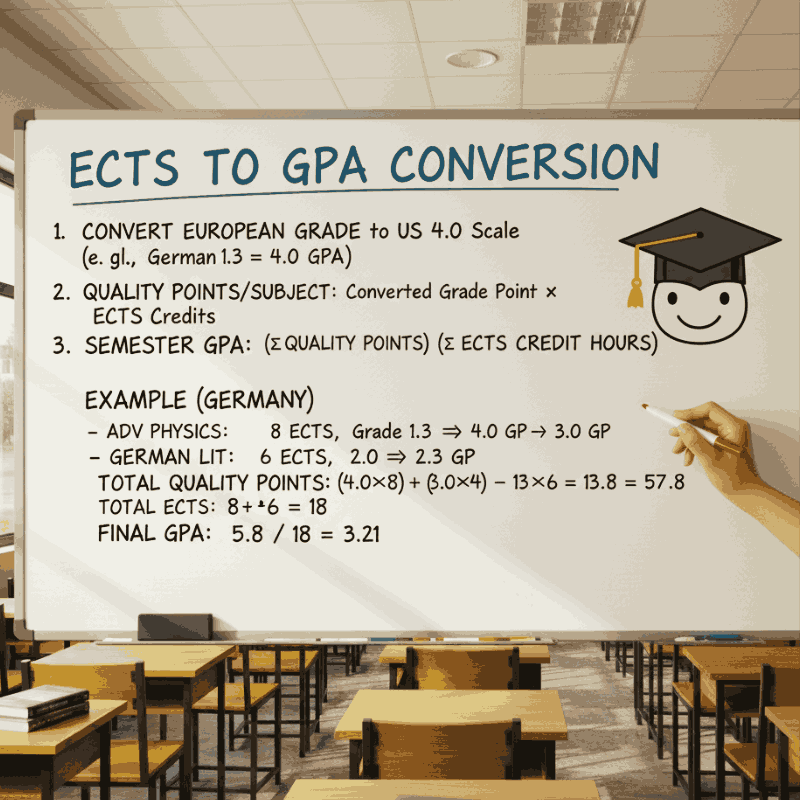
You must convert the European Grade into a US Grade Point (4.0 scale), and use the ECTS credits as the “Credit Hours” weight.
Step 1: Understand the UAF Formula
Formula used:
To adapt this for Europe, we swap the terms:
- US “Credit Hours” will be replaced by ECTS Credits.
- US “Grade Point” must be calculated by converting your European grade.
Step 2: Gather Your Data
Look at your European transcript. For every course, you need:
- The course name.
- The number of ECTS credits assigned to that course.
- The Original Grade you received (e.g., 14/20 in France, 1.7 in Germany).
Step 3: Convert Your Grades to the 4.0 Scale
This is the hardest and most subjective part. Every European country has a different grading scale. You need to find a reliable “conversion table” that translates your specific country’s grades into the US 4.0 scale.
Warning: Different universities use different conversion scales. The examples below are common approximations.
Example A: Germany to US 4.0 Conversion (Approximate)
| German Grade | Description | Approx. US Grade Point |
| 1.0 – 1.3 | Sehr Gut (Very Good) | 3.7 – 4.0 |
| 1.7 – 2.3 | Gut (Good) | 3.0 – 3.3 |
| 2.7 – 3.3 | Befriedigend (Satisfactory) | 2.3 – 2.7 |
| 3.7 – 4.0 | Ausreichend (Sufficient) | 1.0 – 2.0 |
| 5.0 | Nichtausreichend (Fail) | 0.0 |
Example B: France (0-20 Scale) to US 4.0 Conversion (Approximate)
| French Grade | Description | Approx. US Grade Point |
| 16 – 20 | Très bien | 4.0 |
| 14 – 15.9 | Bien | 3.7 |
| 12 – 13.9 | Assez Bien | 3.0 – 3.3 |
| 10 – 11.9 | Passable | 2.0 – 2.7 |
| 0 – 9.9 | Ajourné (Fail) | 0.0 |
Step 4: Calculate the GPA (The Example)
Let’s assume a student took three courses at a German university and wants to convert them using the UAF formula framework.
The Student’s Transcript Data:
- Course 1: Advanced Physics | 8 ECTS | Grade: 1.3 (German)
- Course 2: German Literature | 4 ECTS | Grade: 2.0 (German)
- Course 3: Lab Work | 6 ECTS | Grade: 3.0 (German)
The Calculation:
- Convert Grades: Using the approximate German table above:
- German 1.3 = 4.0 Grade Points2
- German 2.0 = 3.0 Grade Points3
- German 3.0 = 2.3 Grade Points
- Calculate “Quality Points” (Grade Point × ECTS):
- Physics: 4.0 × 8 ECTS = 32.0
- Literature: 3.0 × 4 ECTS = 12.0
- Lab Work: 2.3 × 6 ECTS = 13.8
- Sum the Totals:
- Total Quality Points: 32.0 + 12.0 + 13.8 =57.8$
- Total ECTS Credits: 8 + 4 + 6 =18
- Final Division (Applying the UAF formula):
- GPA = 57.8 (Total Quality Points) / 18 (Total ECTS)
- GPA = 3.21
Example: 180 ECTS to GPA Conversion
A bachelor’s degree in Europe usually equals 180 ECTS credits.
| Course Group | ECTS | ECTS Grade | GPA Value |
|---|---|---|---|
| Core Courses | 120 | B | 3.5 |
| Electives | 60 | C | 3.0 |
(120×3.5+60×3.0)÷180=3.33 GPA
So, 180 ECTS to GPA = 3.33 / 4.0
What Formula Is Used for ECTS to GPA?
There is no single global formula, but universities follow this weighted GPA method:
ECTS to GPA=∑ECTS Credits∑(ECTS Credits×Converted GPA)
That’s why tools like an ECTS to GPA calculator are preferred—they apply this logic instantly and accurately.
How GPA Converts Back to ECTS (Reverse Question)
Many students ask how to convert GPA to ECTS or how do I convert my GPA to ECTS.
Important point:
➡️ GPA cannot be converted into ECTS credits directly.
ECTS credits represent study workload, not grades. However, GPA can be mapped to ECTS grades for transcript evaluation.
Where ECTS to GPA Conversion Is Used
- US & Canadian university admissions
- Erasmus exchange evaluations
- International transcript assessments
- WES and credential evaluation reports
This is why ects credits to gpa conversion matters so much for international students.
User Guide: Best Practices for Students
- Always check your target university’s conversion policy
- Use official transcripts, not estimates
- Include all passed courses
- Do not convert failed (F) credits unless required
- Use a trusted ECTS to GPA calculator for accuracy
Tips to Improve GPA When Using ECTS System
- Focus on high-credit courses first
- Aim for B or higher in core subjects
- Avoid retakes (some universities average attempts)
- Balance workload across semesters
- Track GPA early, not at graduation
Useful FAQs Students Search Online
How to convert ECTS credits to GPA accurately?
You convert ECTS grades into GPA values first, then apply a weighted average using ECTS credits. Credits alone are not enough.
Is 180 ECTS equal to a fixed GPA?
No. 180 ECTS only shows workload. GPA depends entirely on grades earned within those credits.
Do all universities use the same ECTS to GPA scale?
No. Most follow a similar scale, but some universities adjust GPA equivalents slightly for admissions.
Can I use an ECTS to GPA calculator for applications?
Yes. Calculators give accurate estimates, but universities make the final evaluation.
Is ECTS harder than GPA?
ECTS itself is not harder; grading strictness depends on the institution, not the credit system.
Helpful Resources
- ECTS User Guide – European Commission
- University admissions pages (USA, Canada, EU)
- International credential evaluation services
For quick and accurate results, students often rely on tools like:
👉 https://gradewisecalculator.com/ects-credits-to-gpa/
Final Summary
Converting ECTS credits to GPA is not complicated once you understand that grades matter more than credits. By mapping ECTS grades to GPA values and applying a weighted formula, students can confidently present their academic performance for international admissions, evaluations, and transfers.